

The block party was winding down, the kind of late-September evening in Raleigh where the heat finally breaks and neighbors linger on driveways longer than they planned. A mutual neighbor, Sandra, mentioned almost offhandedly that her friend Bonnie had been going through something “with her retirement numbers” — that she’d discovered something unsettling and hadn’t quite stopped thinking about it. A few days later, Bonnie Holloway agreed to sit down with me over coffee at her kitchen table in north Raleigh, a neat ranch house she’s owned since 2011.
Bonnie is 63, a senior insurance claims adjuster with nearly two decades at the same firm. She’s the kind of person who apologizes for the clutter when there is none, who frames her own hardships as minor inconveniences before describing things that are clearly not minor at all. She’s been divorced since 2019, has no children, and has spent the last several years methodically rebuilding her finances after a split that cost her more than she usually lets on.
What Bonnie found when she logged into her Social Security online account in January 2026 was not a crisis, exactly. But it was a number that demanded she rethink a timeline she had quietly built her life around.
The Overtime That Quietly Disappeared
For most of her career, Bonnie’s base salary as a claims adjuster hovered around $74,000 annually. The overtime, though — mandatory during catastrophic weather seasons and major litigation cycles — routinely pushed her gross earnings to between $88,000 and $93,000 in peak years. She depended on that extra income more than she ever quite admitted to herself.
“I always told myself it was a bonus, not a given,” Bonnie told me, turning her coffee mug in a slow circle. “But I’d built my budget around it. The student loans especially. I took those out for a graduate program in risk management and they don’t care whether your firm is having a slow quarter.”
In 2023, her employer restructured its overtime authorization process, requiring management sign-off that rarely materialized. Her gross earnings that year fell to approximately $74,200 — a drop of nearly $18,000 from the prior year. In 2024, she earned $75,100. Two full years of earnings significantly below her historical norm, now permanently part of her record.
The difference — $289 per month — amounts to roughly $3,468 per year in retirement income she had been counting on. Over a 20-year retirement, that compounds into a gap she is still trying to process.
Logging In and Facing the Numbers
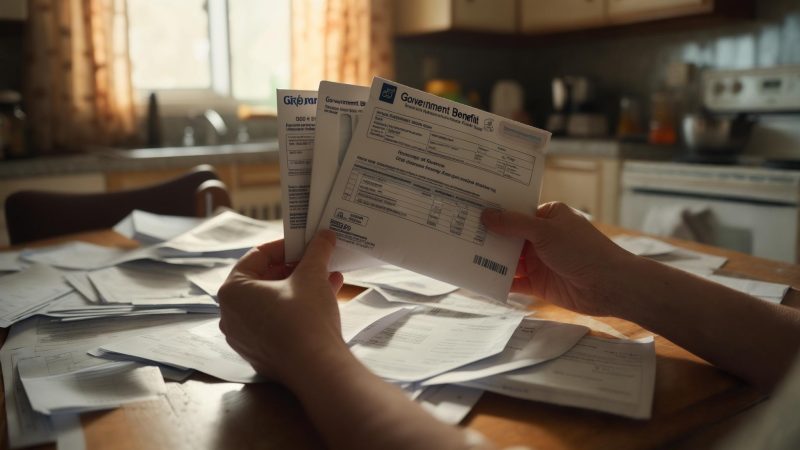
Bonnie had checked her Social Security statement before, but casually — the way you glance at a bank balance when you’re not worried. In January 2026, she opened her my Social Security account with intention for the first time, running through the earnings history screen line by line.
“I actually had to go back and look at it twice,” she said. “I kept thinking I was misreading something. I wasn’t.”
According to the SSA’s benefit calculation methodology, retirement benefits are based on your 35 highest-earning years, adjusted for inflation using Average Wage Indexing. If you’ve worked fewer than 35 years, zeros are factored in. If you’ve worked more, lower-earning years gradually get replaced as higher-earning years accumulate. For Bonnie at 63, those two lean years — 2023 and 2024 — had displaced two previously stronger years in her top-35 calculation.
What made it harder was that the projection she’d mentally anchored to was already factoring in a full retirement age of 67 — the threshold for workers born in 1963, per current SSA rules. She had not planned to claim early. She had planned to work four more years, let the number grow, and step away cleanly.
The COLA Calculation She Misunderstood
One thing Bonnie had taken some comfort in over the past year was the COLA — the annual cost-of-living adjustment that the SSA applies to benefits each January. The 2025 COLA was 2.5 percent, and for 2026 the adjustment came in at a similar modest level. She had read about these increases and, understandably, assumed they would help close the gap the overtime loss had created.
They don’t work that way. COLA adjustments apply to benefits in payment — meaning they increase the amount a recipient receives once they’re already collecting. They do not retroactively boost the projected benefit calculated from your earnings record. The record is the record.
“I had it backwards in my head,” Bonnie admitted. “I thought the COLA was sort of… patching things up. But it only helps once you’re actually receiving checks. The projection number is a different calculation entirely.”
The distinction matters enormously for workers in Bonnie’s position — mid-60s, still employed, with several earning years still ahead. The next four years of her earnings record are still being written. That realization, as she described it, was both the hardest part of the conversation and the part that contained the only real forward motion.
Four Years Left to Write a Different Number
When I asked Bonnie what she planned to do with what she’d learned, she paused for a long moment. She’s not someone who dramatizes things. She refilled both our cups before answering.
She has not, she was careful to tell me, made any decisions about when to claim or how to restructure her finances. That’s work she said she needed to do with a professional, not a journalist. What she has done is confront something she’d been quietly avoiding: the gap between the retirement she imagined and the one her current earnings record supports.
The student loans are still there — approximately $31,400 remaining on a graduate program she completed in 2017. She services the debt on an income-driven plan, but it has constrained her ability to build savings aggressively since the divorce. She doesn’t complain about it. When I brought it up directly, she said only: “That degree got me the promotion that got me the income that kept me afloat. I can’t be too bitter about it.”
That last point — the habit of checking — is the practical thing that shifted for her. Not a plan, not a decision, but a practice. Knowing the number. Watching it change. Not looking away.
What Stays With You After the Coffee Gets Cold
I left Bonnie’s house that afternoon thinking about what it costs to be the kind of person who quietly absorbs the financial fallout of everything around them. The divorce. The graduate loan. The overtime that disappeared without ceremony. None of it was catastrophic in isolation. Together, it had accumulated into a retirement picture that requires more work than she planned for at 63.
The national average monthly Social Security retirement benefit as of early 2026 is approximately $1,976, according to SSA figures. Bonnie’s revised projection of $1,925 at full retirement age puts her just under that average — a sharp contrast to where she thought she stood two years ago. It’s not the story she expected to be telling at 63.
But she is telling it, clearly and without flinching, at her kitchen table in north Raleigh. That counts for something. The numbers on her SSA statement are not fixed yet. Neither, she seemed determined to remind me, is she.



Leave a Reply