
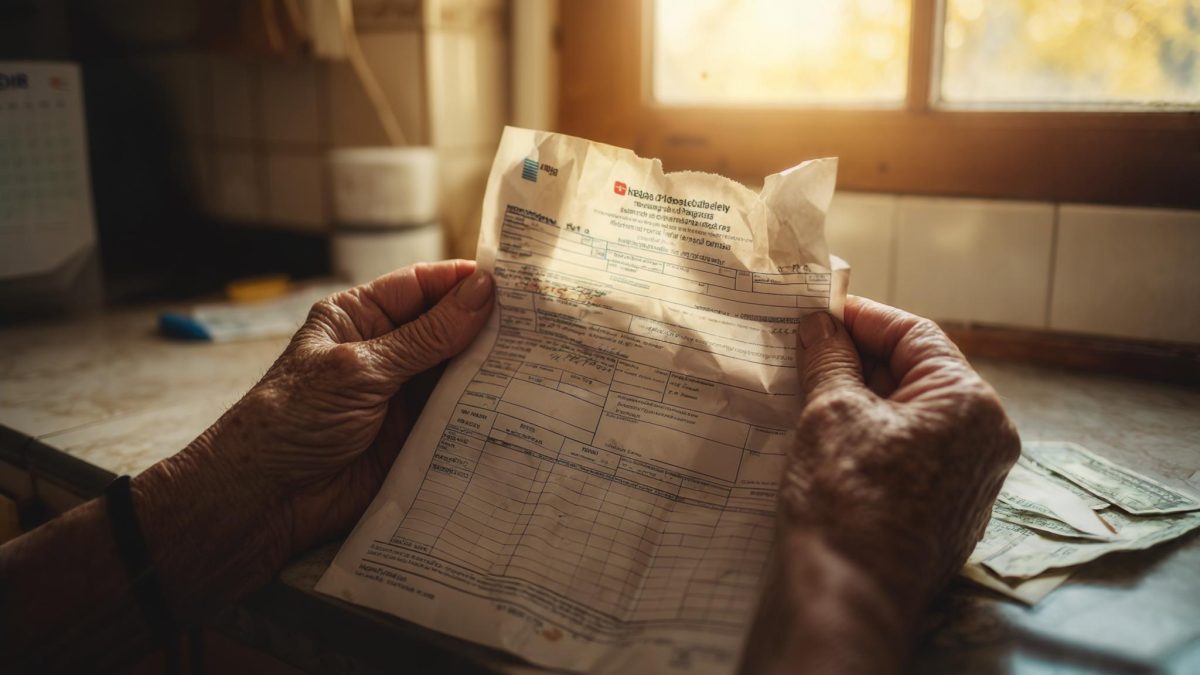
The Facebook group was called “Retirement Planning and Social Security Help” — not exactly where you’d expect to find a 45-year-old still in the workforce. But that’s where I found Sylvia Patel last February, posting a question that stopped me mid-scroll: “Can they really deny you workers’ comp AND Social Security disability? Because that’s apparently what’s happening to me.” I sent her a direct message that afternoon. She replied within minutes.
When I sat down with Sylvia Patel over a video call three days later, she was in her apartment in Atlanta’s East Point neighborhood, her arm resting on a pillow propped against the desk. She moved carefully. She explained she always does now — ever since November 14, 2024, when a defective stockroom ladder gave way beneath her at the retail chain where she’d managed a store for six years.
A Fall That Unraveled Everything
Sylvia told me the ladder collapsed when she was approximately eight feet off the ground, reaching for holiday inventory on an upper shelf. She landed hard on her left side, fracturing a rib and herniating two discs in her lower lumbar spine. Her store’s district manager was on-site and filed an incident report that same evening.
“I thought it was going to be straightforward,” Sylvia told me. “There were cameras. There was a witness. The ladder had been flagged for replacement in a maintenance log two months earlier. I didn’t think I’d even need to fight.”
She was wrong. On January 8, 2025 — less than two months after the fall — her employer’s workers’ compensation insurer issued a formal denial. The reason cited: a pre-existing degenerative disc condition documented in medical records from a 2019 back strain. Sylvia’s attorney told her the insurer argued the fall hadn’t caused her injury, merely aggravated an existing one.
Sylvia’s annual salary as a store manager had been $72,000 — a figure she’d built steadily over years of retail promotions. After the injury, she was placed on unpaid medical leave. By March 2025, with no workers’ comp payments coming in and medical bills arriving weekly, she filed for SSDI.
What the SSDI Process Actually Looks Like From the Inside
Sylvia filed her initial SSDI application on March 19, 2025 — online, through the Social Security Administration’s portal. She had documentation from two spine specialists, a physical therapist, and her emergency room records. She was thorough. She was optimistic.
The SSA’s standard processing time for an initial disability determination is roughly three to six months. Sylvia received her decision on August 22, 2025: denied. The letter stated she had not provided sufficient evidence that her condition prevented her from performing any substantial gainful activity.
“I read that letter four times,” Sylvia told me. “I thought: I am in pain every single day. I cannot stand for more than twenty minutes. I manage a team of eighteen people for a living and I can’t walk through a store floor anymore. And they said not enough evidence.” She paused. “I didn’t know who to be angry at. I was just angry everywhere.”
She filed her Request for Reconsideration on October 3, 2025. That appeal was denied on December 29, 2025 — a result that, according to SSA data, affects roughly 87% of reconsideration filers. Her next step is requesting a hearing before an Administrative Law Judge, which her attorney filed for in January 2026. The estimated wait for a hearing in the Atlanta region: 12 to 18 months.
The Credit Score Nobody Warned Her About
While the SSDI appeals process ground forward, another system was quietly unraveling. Sylvia’s credit score — which she told me had sat around 718 before the injury — had dropped to approximately 574 by the time we spoke in February 2026. The cause was not recklessness. It was arithmetic.
Without income, she had accumulated roughly $34,000 in medical bills, including two rounds of epidural steroid injections at $4,200 each, physical therapy sessions billed at $280 per visit, and an MRI that her insurance only partially covered. Three accounts went to collections. She missed two months of credit card minimum payments in the spring of 2025 while waiting for a hardship deferment to be processed.
“I had good credit,” Sylvia said, her voice flat. “I worked for it. I didn’t make dumb decisions. I got hurt at work and now my credit score looks like I was irresponsible my whole life. How do you explain that on a rental application?”
She and her roommate have been sharing rent in a two-bedroom apartment — a situation Sylvia described as both a lifeline and a source of daily stress. She is currently receiving no income. No workers’ comp. No SSDI. Her savings, which she said totaled roughly $18,000 when the injury occurred, are nearly gone.
The SSDI Timeline She Faces — and What It Means
As Sylvia awaits her ALJ hearing, the financial clock keeps running. The SSDI back-pay provision does offer some future relief: if she is ultimately approved, she would receive retroactive payments dating back to her established disability onset date — potentially 12 to 18 months of benefits. At an estimated $2,100 per month, that could represent $25,000 to $37,800 in back pay, minus any applicable offsets.
But “potentially” is doing a lot of heavy lifting in that sentence. Approximately 55% of SSDI applicants who reach the ALJ hearing stage are ultimately approved, according to SSA statistics. That means roughly 45% are not. And even those who win often wait years before seeing a check.
When I asked Sylvia whether she regretted how she had handled any step of the process, she was quiet for a moment. “I regret trusting that doing it right would be enough,” she finally said. “I submitted everything. I followed every instruction. I met every deadline. And I’m still sitting here with nothing.”
What Sylvia’s Story Reveals About the Gap Between Programs
One of the more disorienting aspects of Sylvia’s situation — and one that came up repeatedly in our conversation — is how completely the workers’ compensation and SSDI systems operate in isolation from each other. A denial in one does not trigger any automatic assistance from the other. There is no bridge.
For someone like Sylvia — high earner, no dependents, single — the absence of a safety net between those two systems is starker than it might be for someone with a spouse’s income or a larger financial cushion. “People think because I was making good money that I have some kind of cushion,” she told me. “But I was living my life. I wasn’t preparing for a ladder to break.”
Her anger, she said, isn’t really at any single person or office. It’s at a structure that treats people in crisis as applicants to be processed rather than workers to be supported. I didn’t have a comfortable response to that. I’m not sure one exists.
As of March 31, 2026, Sylvia Patel is waiting for a hearing date. She has not received a single dollar from either workers’ compensation or SSDI. She manages her pain with over-the-counter anti-inflammatories because the prescription regimen she was on became unaffordable. She is 45 years old and has no clear sense of when — or whether — any of this ends in her favor.
“I got into that Facebook group because someone in there had been through the same thing,” she told me as we wrapped up. “I needed to know it was possible to come out the other side. I’m still looking for that answer.”
Related: Denied Workers’ Comp at 35 With a Toddler at Home: One Bank Teller’s Fight to Stay Afloat




Leave a Reply