

What would you do if the payment you spent decades earning arrived — and it still wasn’t enough? That question sat with me for days after I first heard about Yvonne Velasquez, a 65-year-old bank teller from El Paso, Texas, whose story reached me through a mutual friend at a neighborhood barbecue last November.
Our friend pulled me aside near the end of the evening and said, quietly, “You should talk to Yvonne. She finally got her Social Security and it’s not going the way she thought.” I found Yvonne near the cooler, laughing loudly at someone’s story. She had the practiced composure of a person who has learned to wear good spirits as armor. When I introduced myself and explained what I write about, she paused, looked at her husband across the yard, and said, “Yeah. Okay. Let’s do that.”
We met three weeks later at a diner two blocks from the bank branch where she still works full-time. Over coffee that neither of us touched while it was hot, she told me everything.
A Career Built on Financial Stability — From the Outside
On paper, Yvonne Velasquez looks like someone who had it figured out. Twenty-eight years at the same regional bank. A husband who stayed home to raise their three children, the youngest of whom is now nine. A graduate degree in finance she finished at 47 — a decision she describes as “either the smartest or the dumbest thing I ever did, depending on the month.”
The graduate degree cost her roughly $41,000 in federal loans. As of January 2026, she still carries $17,200 of that balance. Her monthly income-driven repayment comes to $384. “I used to think I’d have it paid off before I retired,” she told me. “Then we had our youngest. Then my mother got sick. Then my husband’s back surgery happened and the insurance didn’t cover what we thought it would.”
The back surgery left a $14,800 balance on a credit card she opened specifically for medical expenses in 2023. By the time she filed for Social Security in late 2025, minimum payments on that card were running $318 per month. On top of that, after-school care and summer programs for her youngest child cost the family approximately $1,100 per month — a number that stunned me when she said it aloud so matter-of-factly.
“I work at a bank,” she said, with a short laugh. “I know what these numbers mean. I’ve helped customers understand their finances my whole career. It’s different when it’s yours.”
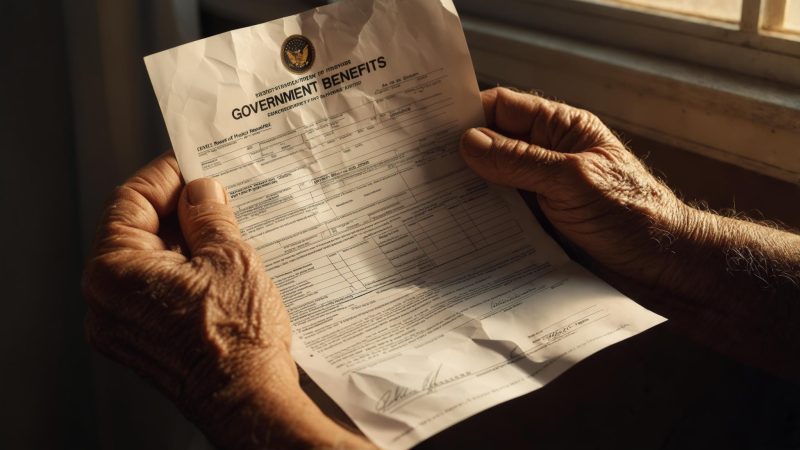
Filing at 65: What the SSA Letter Said and What It Didn’t
Yvonne reached her full retirement age of 67 in 2028 — but she filed for Social Security retirement benefits in October 2025, two years early, at age 65. Under current SSA early filing rules, claiming before full retirement age permanently reduces your monthly benefit. For Yvonne, that reduction came to approximately 13.3 percent off her projected full benefit of $2,130.
Her first deposit — $1,847 — arrived on January 22, 2026, the fourth Wednesday of the month, which aligns with her birth date falling in the second half of the month under the SSA’s birth-date payment schedule. She had been checking her bank account since the 8th.
She chose to file early because the family needed the additional income stream now, not in two years. Her husband’s back condition limits his ability to re-enter the workforce in any sustained way. Waiting until 67 for a higher monthly check was a luxury she felt she couldn’t afford, even though she understood clearly what the reduction meant.
The COLA That Arrived With the Check — and What It Actually Changed
January 2026 also brought the implementation of the 2026 Cost-of-Living Adjustment. The SSA announced a 2.6% COLA for 2026, calculated using the Consumer Price Index for Urban Wage Earners and Clerical Workers (CPI-W). For Yvonne, that adjustment was already baked into her very first check — she had no previous benefit amount to compare it against.
“Everyone kept telling me, ‘You’re getting a raise in January,'” she said. “I didn’t have the heart to tell them I hadn’t gotten the first check yet. There was no raise. There was just… the number.”
For context, the average monthly Social Security retirement benefit as of January 2026 sits at approximately $1,976, according to SSA estimates. Yvonne’s $1,847 falls below that average, partly due to her early filing reduction and partly because her highest earning years were in a mid-level wage bracket as a bank employee rather than a high-earning professional role.
Running the Numbers at the Kitchen Table
When Yvonne and her husband sat down in late January to map out their monthly budget with the new income stream added, the arithmetic was uncomfortable. She walked me through it at the diner, pulling up a notes app on her phone where she’d typed the figures.
The combined income of roughly $5,487 per month, before housing, groceries, utilities, and transportation, is being met by obligations that alone consume over $1,800. “We’re not drowning,” Yvonne told me. “But we’re not swimming either. We’re just… holding our heads up.”
She said the word “fine” three times during our conversation — always right after I asked how she was managing. I noticed it each time.
What She Wishes She Had Known Before Filing
The tension in Yvonne’s story isn’t that she made a careless mistake. It’s that she made a reasonable decision with incomplete emotional preparation. She researched the numbers. She understood the reduction. What she didn’t anticipate was how it would feel to have her financial life consolidated into a single monthly figure deposited on a Wednesday.
She also expressed something that surprised me: mild frustration with the COLA conversation dominating news coverage in late 2025. For retirees who had been collecting benefits for years, a 2.6% increase meant a tangible bump — roughly $49 more per month on an average check. For Yvonne, entering the system for the first time, the COLA headlines felt disconnected from her actual situation.
“I kept seeing articles about how retirees were getting more money in January,” she said. “I thought that included me. It didn’t feel like more money. It just felt like the money I was finally getting.”
Three Months In: Where Things Stand
When I followed up with Yvonne by phone in late March 2026, she had received three Social Security deposits — January 22, February 25, and March 25. Each one landed as expected, with no interruptions or discrepancies. “At least the schedule is reliable,” she said. “I’ll give them that.”
She and her husband have started tracking expenses more granularly than before, using a shared spreadsheet she built using templates from her work training materials. The medical credit card balance has dropped to $13,940 — modest progress, but progress. Her youngest’s after-school costs will decrease in September when the child enters fourth grade and qualifies for the school’s lower-cost extended-day program, dropping the monthly childcare expense to approximately $620.
She is not planning to stop working at the bank anytime soon. Her Social Security income, combined with her salary, keeps the household above water — though not with the margin she had hoped for when she first sat across from an SSA representative in October 2025 and signed her application.
As I drove back from El Paso, I kept thinking about the gap Yvonne named so precisely: the distance between a projection on a screen and money in an account that has to cover real things. She didn’t fail to plan. Life simply accumulated faster than the plan could absorb it.
She is one of the roughly 52 million retired workers currently receiving Social Security retirement benefits in the United States. Most of them have a version of this story. Not all of them talk about it. Yvonne did, over cold coffee, because she thought it might help someone else feel less alone in the parking lot on a Wednesday morning.
Related: Buried in Bills at 44, He Checked His Social Security Record and Found an Error Worth Thousands
Related: The $14,000 Loan She Cosigned Destroyed Her Path to Social Security at 62



Leave a Reply