
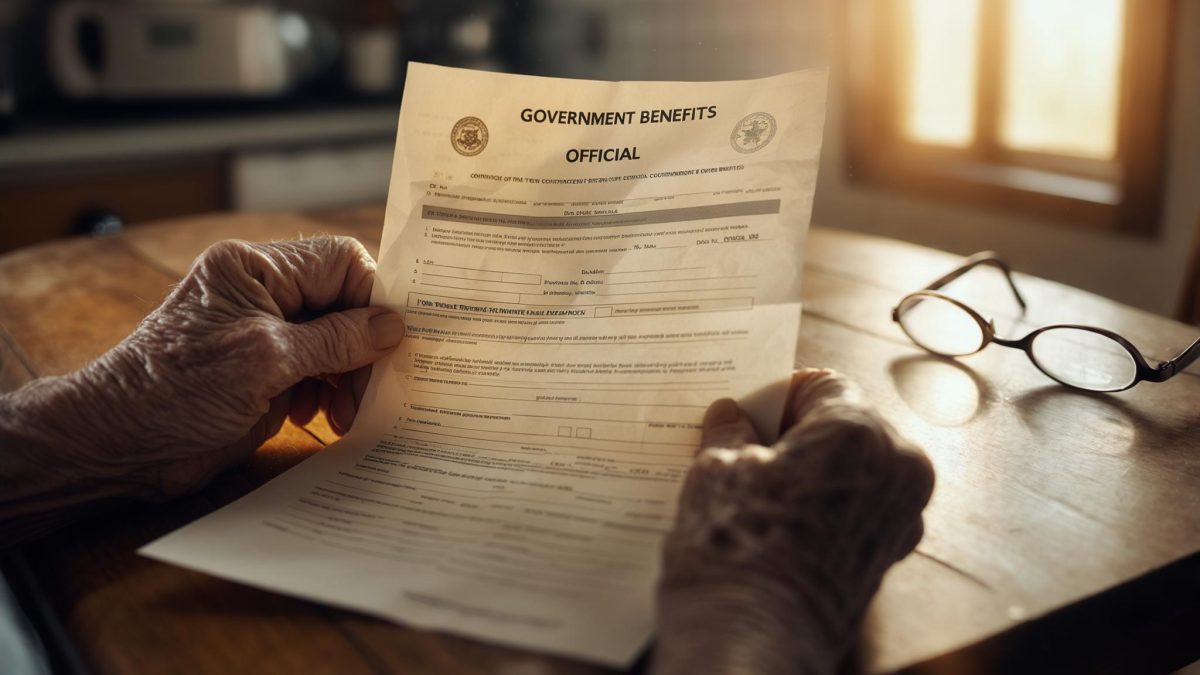
Most financial planners will tell you that checking your Social Security statement is a yearly ritual. What they rarely tell you is what happens when you open it and the number looking back at you is nothing like the one you remembered from five years ago.
When I sat down with Carlos Mendez at a corner booth in the Hialeah diner where he now works as a floor manager, he slid his phone across the table without saying a word. On the screen was his SSA My Account statement. His projected monthly benefit at age 67 — his full retirement age — read $1,583. The last time he’d checked, before COVID, it had been closer to $1,920.
That gap of roughly $337 per month represents something specific: fourteen months of zero reported earnings during the pandemic, followed by a lower-wage job he’s held ever since. Carlos didn’t do anything wrong. He just lived through 2020 and 2021 — and his Social Security record absorbed every bit of it.
How Carlos Got Here: A Restaurant Career Interrupted
Carlos Mendez spent 28 years climbing through the ranks of Miami’s restaurant industry. He started bussing tables at 19, moved into kitchen management through his thirties, and by 2019 was managing a mid-size Cuban restaurant in Coral Gables that pulled in consistent business from the local lunch crowd and weekend tourists.
When the restaurant closed in March 2020, Carlos believed it was temporary. He told me he dipped into savings to cover his family’s expenses for what he assumed would be a few months. It lasted fourteen. By the time he found a new management position in May 2021, the savings account he’d spent nearly a decade building — roughly $41,000 — was gone.
His new position pays $52,000 a year — about $19,000 less than he was earning before the closure. He and his wife Maria are raising four children together: two from his first marriage, ages 14 and 11, and two from her previous relationship, ages 13 and 9. Her ex contributes child support inconsistently — Carlos described months where the payments arrive and stretches of two or three months where they simply don’t.
“We budget around what we know is coming in,” Carlos told me. “What he sends, if it comes, that goes straight to the kids’ stuff. But I stopped counting on it a long time ago.”
Opening the Statement: What the Numbers Actually Mean
Carlos told me he hadn’t looked at his Social Security statement in years. He logged into his SSA My Account profile for the first time in about four years last December, expecting something close to what he remembered. The drop stopped him cold.
According to the SSA’s retirement planner, benefits are calculated using a worker’s 35 highest-earning years. When someone has fewer than 35 years of covered earnings, the SSA fills in the remaining years with zeros. Carlos has been working and paying into the system since he was 19 — but those two zero-income years during the pandemic now count among his 35, pulling down the average that determines his benefit.
What made it worse is that his current salary — $52,000 — is replacing years in his record where he was earning $68,000 to $71,000. The recalculation doesn’t just reflect the pandemic gap. It reflects every year going forward at the lower wage.
The Dependent Benefits Discovery — and Why It Was Complicated
During my conversation with Carlos, he mentioned something a coworker had brought up: that his minor children might qualify for Social Security dependent benefits on his earnings record if he were to become disabled or die. He had never looked into it seriously, but with four kids in the house and no savings cushion, the idea had stuck with him.
What he discovered when he called the SSA was accurate but not as immediately helpful as he’d hoped. Social Security does allow eligible dependent children to receive benefits — up to 50% of a worker’s benefit — if that worker becomes disabled or begins drawing retirement benefits. But Carlos is 55 and still working. His children wouldn’t receive anything unless one of those triggering conditions occurred.
There is also the question of his stepchildren. Two of the four kids in his household are his wife’s biological children from her previous marriage. SSA dependent benefits on Carlos’s record would not automatically extend to stepchildren unless he legally adopted them, which he has not done. That detail landed quietly but heavily in our conversation.
The Math at 55: What Claiming Early Would Actually Cost
Carlos’s full retirement age, based on his birth year of 1971, is 67. If he claims at 62 — the earliest possible age — his benefit would be permanently reduced. According to the SSA’s age reduction tables, claiming at 62 can reduce a benefit by approximately 30% compared to waiting until full retirement age.
On his current projection, that would take his $1,583 monthly benefit down to roughly $1,108. Over a 20-year retirement, the cumulative difference between claiming at 62 versus 67 runs into the tens of thousands of dollars — assuming he lives into his eighties, which he told me he fully expects to do.
“Sixty-two is looking real attractive right now,” Carlos told me, and then laughed in a way that didn’t sound like he found it funny. “But I know what taking the smaller number means for the rest of my life. I’m just not sure I have the luxury of waiting.”
Living It at 55: The Emotional Weight Behind the Numbers
There is a particular kind of stress that comes with being the person everyone else is counting on. Carlos described it without self-pity — almost clinically, the way someone talks about weather when they’ve been rained on long enough to stop being surprised.
He told me that when the child support checks from his wife’s ex don’t arrive, he doesn’t tell her right away. He adjusts the grocery list. He skips replacing the work shoes he needs. “The kids don’t need to know there’s a gap,” he said. “That’s not their problem. That’s mine.”
He is aware that the 2025 COLA increase of 2.5% — which boosted the average Social Security retirement benefit to approximately $1,976 per month according to SSA data — applies to people already receiving benefits, not to projected future payments. For Carlos, who is still twelve years from his full retirement age, the annual COLA adjustments are a comfort in theory but not in practice. His projection adjusts based on earnings, not inflation.
When I asked him what he wished he had known earlier, he paused for a long time. Long enough that I stopped expecting an answer.
“I wish I’d known that zero is a number,” he finally said. “When you’re not working and you’re not getting paid, you think nothing is happening. But something is happening. The SSA is writing down a zero next to your name, and you’re going to carry that forever.”
Carlos Mendez is not broken. He’s still working the same early shifts, still folding napkins before the lunch rush, still the person who slips his youngest stepkid an extra twenty when she needs something for school. But the Social Security statement on his phone tells a story that his generosity can’t edit: two years of zeros, a salary that came back lower, and a projection that quietly rewrote his future while he was busy surviving the present.
He plans to keep working past 65 if his body allows. He’s not sure it will. He told me that as we stood up to leave, without drama, the way people state facts they’ve already made peace with. I drove home thinking about that gap between $1,920 and $1,583 — and how many more Carlos Mendezes are out there who haven’t opened that statement yet.
Related: The Oil Price Dip That Made This Houston Engineer Finally Open His Social Security Statement




Leave a Reply