

The window for catching Social Security earning errors is narrow — the Social Security Administration recommends reviewing your earnings record annually, since corrections become harder to make the further back the discrepancy goes. For most working Americans, that annual check feels like a formality. For Duane Neville, opening his statement in February 2026 turned into something else entirely.
I first connected with Duane after posting a call for sources on social media in early March 2026. I was looking for working adults — not retirees — who had recently experienced a shock to their Social Security projections. Duane responded the same day. “I’ve been wanting to talk about this,” he wrote, “because nobody warned me this could happen.”
We met over video call on a Tuesday afternoon, just after he’d finished a 24-hour shift at Omaha Fire Station 12. He was still in his station gear, visibly tired, and had a directness about him that made the conversation feel more like a debrief than an interview.
A Budget Built on Overtime That Disappeared
Duane Neville is 49 years old, has been a firefighter with the Omaha Fire Department for 22 years, and earns a base salary of approximately $78,000 annually. On paper, that sounds stable. In practice, Duane told me, his budget for the past decade had been built around something else entirely.
“Overtime was never extra money for me,” he said. “It was the money. My base covered the mortgage and utilities. Overtime covered everything else — my sister’s tuition, the car, the credit card I’ve been paying down since 2019.”
That credit card is tied to a chapter Duane doesn’t dwell on. A foreclosure in 2019 — after a bad investment decision involving a rental property — damaged his credit score significantly, dropping it from the mid-700s to below 580. He’s been rebuilding since, but the high-interest debt that followed has never fully gone away.
Starting around 2015, Duane was consistently pulling in an additional $20,000 to $24,000 per year in overtime. In 2024, that figure was $22,400. Then, in January 2025, the Omaha Fire Department implemented staffing changes that effectively eliminated most voluntary overtime shifts. Duane’s overtime income dropped to roughly $3,100 for the entire year — a reduction of more than $19,000.
He adjusted. He deferred a planned car repair, paused two minor savings contributions, and had a difficult conversation with his younger sister, Kelsey, 22, who is a junior at the University of Nebraska-Lincoln. Duane has been helping cover her tuition since she enrolled. “I told her I could still do it, but I needed her to apply for every scholarship she hadn’t gotten around to,” he said. “She did. She got two.”
The Statement Nobody Prepares You to Read
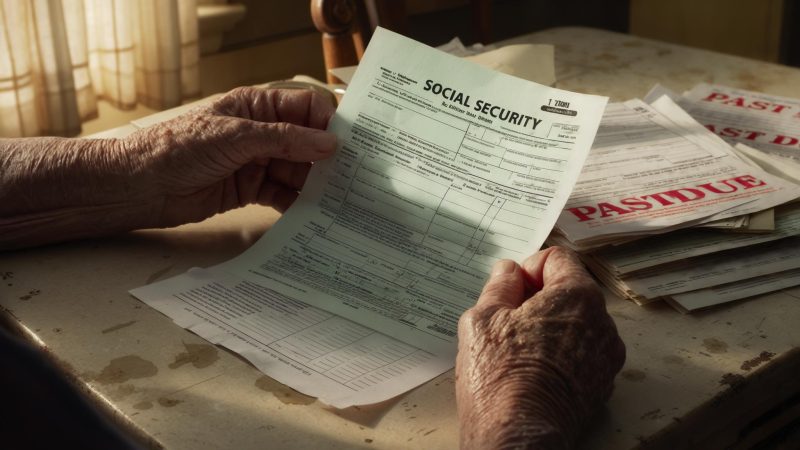
In February 2026, Duane logged into his My Social Security account for the first time in about 18 months. He had checked it briefly in 2024, mostly out of curiosity, and the projected retirement benefit at age 67 had read $2,340 per month. He remembered that number. It had felt reassuring — not life-changing, but solid enough to feel like a foundation.
The updated figure was $1,978 per month.
“I sat there for probably ten minutes just staring at it,” Duane told me. “I thought maybe it was a mistake. Like maybe the site hadn’t updated something. So I went through my earnings record line by line.”
It wasn’t a mistake. The Social Security Administration calculates retirement benefits using a worker’s 35 highest-earning years. Duane’s 2025 earnings — with overtime stripped out — had replaced what had previously been one of his strongest income years in the formula. The math worked exactly as designed. The result was a projected monthly benefit roughly $362 lower than what he’d seen 18 months earlier.
Where the 2025 COLA Fit Into This Picture
The 2.5% Cost-of-Living Adjustment for 2025 — which took effect for Social Security recipients in January of that year — was the smallest COLA since 2021. For someone already receiving benefits, it added an average of roughly $49 to monthly checks, based on the average benefit at the time. For Duane, who is not yet collecting, it was a data point rather than a deposit.
Still, he tracked it. He had started paying attention to COLA announcements in a way he hadn’t before — partly because his father, 74, receives Social Security and had called Duane in October 2024 asking what the increase would mean for him. Duane walked his father through the numbers. That exercise made him think more carefully about his own trajectory.
“The COLA helps my dad. That’s real,” Duane said. “For me, it’s a different conversation. COLA adjusts what you’re already getting. It doesn’t fix a projection that moved the wrong direction.”
He’s right in a narrow sense. COLA increases are applied to benefits in payment — they do not retroactively adjust the base benefit calculation that happens at the time someone claims. The projection Duane was looking at on his statement already incorporated expected future COLAs in its estimate framework, but the base figure had shifted because of his 2025 earnings.
A Payment Schedule He Hadn’t Thought About Until Now
One unexpected turn in my conversation with Duane came when he mentioned that he had also been looking into Social Security payment dates — not for himself, but again for his father, whose payment had seemed to arrive later than expected in January 2026.
Social Security pays retirement benefits according to a schedule tied to the recipient’s birth date: those born on the 1st through 10th receive payment on the second Wednesday of the month; the 11th through 20th on the third Wednesday; and the 21st through 31st on the fourth Wednesday, according to SSA’s official payment schedule.
Duane’s father was born on January 19th, placing him in the third-Wednesday cohort. In January 2026, that fell on January 21st. His father had been expecting it on the 14th — the second Wednesday — because a neighbor had mentioned receiving payment that day. “He called me twice in three days thinking his check was lost,” Duane told me. “I had to pull up the SSA website and walk him through the whole birth date schedule. He had no idea it worked that way.”
That episode pushed Duane deeper into researching the SSA’s systems generally — which is ultimately what led him to log into his own account and discover the projection change. A frustrating detour that became a harder reckoning.
What Duane Is Left With — and What He’s Still Bitter About
When I asked Duane how he’s processing all of this, he paused longer than he had at any other point in our conversation. He’s 49. He has 18 years before full retirement age at 67. Mathematically, there is time to rebuild earnings years. But as he explained it, the bitterness isn’t really about the math.
“I did everything right for 22 years,” he said. “I showed up. I paid in. I didn’t game any system. And one budget cycle — one decision made by administrators I’ve never met — and my retirement picture changes permanently unless I work harder to fix it. That’s the part that eats at me.”
He’s not wrong that recovery is possible. High-earning years between now and 67 can displace the 2025 dip in his 35-year calculation. But Duane is realistic about what that requires. His base salary of $78,000 is solid, and overtime may return — the department is currently recruiting, and some senior firefighters have told him shifts will open back up in late 2026. But he’s not counting on it.
Kelsey, his sister, is on track to graduate in December 2026. Duane told me that milestone matters more to him right now than any retirement number. “When she walks across that stage, that’s money well spent,” he said. “No regrets on that one.”
The credit score, the lost overtime, the quieter SS projection — these are three separate wounds that arrived in overlapping years and haven’t fully healed. Duane isn’t catastrophizing. He’s calculating. And there’s something in that deliberateness — the firefighter who runs toward problems and figures them out — that made our conversation feel less like a cautionary tale and more like a work in progress.
He told me near the end of our call that he plans to check his My Social Security statement every January going forward, the way other people check a smoke detector. “I should have been doing it all along,” he said. “Now I know why.”
Related: The $14,000 Loan She Cosigned Destroyed Her Path to Social Security at 62



Leave a Reply